Thursday, 30 April 2026

Selecting Steel Pipe Fittings and Flanges for Water and Wastewater Treatment

 The infrastructure of modern water and wastewater treatment (W/WWT) plants relies on the integrity of their piping systems. Unlike standard commercial plumbing, W/WWT environments are punishing—subjecting components to corrosive chemicals, abrasive slurries, and fluctuating pressures. Choosing the right steel pipe fittings and flanges is not just a matter of compatibility; it is a critical decision for operational safety and long-term cost management.

Selecting Steel Pipe Fittings and Flanges for Water and Wastewater Treatment

Water/Wastewater Treatment: How to Choose Steel Pipe Fittings and Flanges?

Selecting components for water systems requires a balance between material longevity and project budget. The choice typically boils down to three primary factors:

Corrosion Resistance and Material Grade
Stainless Steel (304/316L): The gold standard for treated water and chemical dosing lines. 316L is preferred for its superior resistance to chlorides and acidic environments found in sludge treatment.
Carbon Steel with Specialized Coatings: For large-diameter raw water mains, carbon steel is cost-effective. However, it must be protected by internal linings (like liquid epoxy or cement mortar) and external coatings (such as Fusion Bonded Epoxy – FBE) to prevent oxidation.

Fluid Chemistry and Media
Are you transporting raw sewage, potable water, or industrial effluent? Raw sewage contains hydrogen sulfide (H₂S), which can lead to rapid microbial-induced corrosion. In these cases, high-nickel alloys or heavy-duty galvanized fittings are essential.

Pressure and Temperature Ratings
Wastewater systems often experience “water hammer” or pressure surges. Ensure your fittings (Elbows, Tees, Reducers) are rated for the maximum surge pressure, not just the steady-state operating pressure.

Steel Pipe Fitting and Flange Standards in the Water/Wastewater Treatment Industry

To ensure interchangeability and safety, W/WWT projects must adhere to strict international standards. At HB Steel, we emphasize compliance with the following:

AWWA Standards (American Water Works Association):
AWWA C207: This is the most critical standard for steel pipe flanges used in waterworks service. Unlike ASME flanges, AWWA C207 flanges are specifically designed for lower pressure (typically under 300 psi) but larger diameters.
AWWA C110/C153: Covers ductile iron and gray iron fittings, but often serves as a benchmark for steel alternatives in similar applications.

ASME/ANSI Standards:
ASME B16.9: For factory-made wrought butt-welding fittings.
ASME B16.5: For pipe flanges and flanged fittings (Class 150 to 2500). Used primarily in high-pressure pumping stations within the plant.

ASTM Specifications:
ASTM A234 WPB: The standard for carbon steel fittings for moderate and high-temperature service.
ASTM A182: The standard for forged or rolled alloy and stainless steel pipe flanges and fittings.
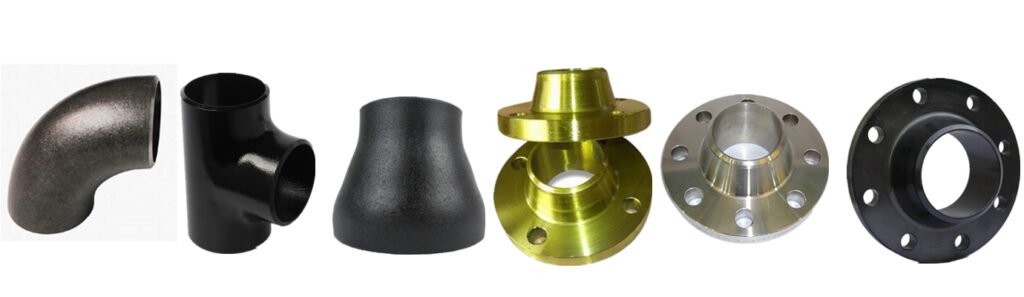
carbonsteel  buttweld pipe fitting and flange manufacturer

Water/Wastewater Treatment: How to Use or Order Steel Pipe Fittings and Flanges?

Ordering for a large-scale water project requires precision to avoid costly onsite delays. Follow this technical checklist when placing an order:
Specify the End Connection: Clearly state whether you require Butt-weld (BW), Socket-weld (SW), or Threaded (NPT) ends. For large-diameter municipal lines, Butt-weld is the industry standard for leak prevention.
Define the Wall Thickness (Schedule): Don’t just say “standard.” Specify Schedule 10s, 40s, or 80. In wastewater, a thicker wall (Schedule 80) is often used for abrasive sludge lines to extend the wear life.
Flange Face Selection: For water applications, Flat Face (FF) flanges are common when connecting to cast iron pumps or valves to prevent cracking the flange. Raised Face (RF) is used for steel-to-steel high-pressure connections.
Request Certification: Always demand the Mill Test Certificate (MTC). This ensures the chemical composition (Chromium, Nickel, Carbon content) matches the project specifications.

Partnering with a Specialist Steel Pipe Fitting and Flange Supplier

The complexity of water treatment infrastructure requires more than just a vendor; it requires a technical partner.
As a dedicated steel pipe fitting and flange supplier, Henan Huabao Iron and Steel (HB Steel) understands the nuances of municipal and industrial water projects. We provide:
Material Diversity: From standard A105 carbon steel flanges to specialized 316L stainless steel elbows.
Custom Coating Services: We offer internal and external epoxy coatings that meet AWWA standards for corrosion protection.
Global Logistics Experience: We understand the packaging requirements to prevent flange face damage during international transit.
Whether you are upgrading a municipal desalination plant or constructing a new industrial effluent system, the quality of your connections determines the success of your flow system.

Need a technical consultation or a bulk quote for your next water project?

Why High-Grade Stainless Steel Flanges Define Marine Engineering?

 In the global maritime industry—from the bustling shipyards of Singapore to the offshore platforms in the North Sea—the integrity of a vessel’s piping system is non-negotiable. For procurement officers and marine engineers, the challenge isn’t just finding a component; it’s securing a supply chain that can handle the scale, corrosive volatility, and rigorous certification requirements of modern shipbuilding.

As a leading Chinese industry steel flange manufacturer and bulk supplier, Rayoung specializes in bridging the gap between high-specification engineering and large-scale industrial supply.

leading Chinese industry steel flange manufacturer and bulk supplier

The Marine Environment: Why Stainless Steel is Non-Negotiable?

Marine piping systems are constantly besieged by chloride-rich seawater, extreme salt spray, and fluctuating internal pressures. Standard carbon steel, while cost-effective for inland use, fails rapidly in these conditions without expensive and heavy linings.
Stainless Steel Flanges (specifically Grades 316L and Duplex) have become the industry standard for several critical reasons:

  • Pitting Resistance: The molybdenum content in 316L stainless steel provides essential protection against pitting and crevice corrosion in saline environments.
  • Structural Integrity under Pressure: In shipboard fire-fighting systems and ballast water treatment, flanges must maintain a perfect seal despite the vibration and “hull flexing” of a vessel at sea.
  • Thermal Stability: From cryogenic LNG carriers to high-temperature engine exhaust systems, stainless steel maintains its mechanical properties where other materials become brittle or deform.

The Chinese Factory Advantage: Scaling for Large-Volume Marine Industry Procurement

While many suppliers in hubs like Singapore or Dubai act as stockists, we operate as a direct-to-project manufacturer. For international shipyards and large-scale marine contractors, this distinction is vital.

  1. Mass Production Efficiency
    Marine projects rarely require a handful of flanges; they require thousands of units across varying schedules and sizes. Our facility is optimized for bulk orders, ensuring that large-scale procurement does not lead to “staggered” delivery dates that stall shipyard production lines.
  2. Direct Mill Control and Traceability
    Buying direct from a Chinese factory eliminates the “middleman markup” and, more importantly, ensures 100% traceability. Every flange we ship is accompanied by an EN 10204 3.1 Mill Test Certificate (MTC), documenting the precise chemical composition and mechanical testing required by maritime Class Societies (such as ABS, DNV, or LR).
  3. Extensive Inventory & Raw Material Reserves
    Supply chain volatility can ruin project timelines. Our factory maintains a massive standing inventory of raw billets and semi-finished flanges. This allows us to move from order to shipment in a fraction of the time required by smaller distributors who must wait for third-party mill runs.

Technical Standards for Marine Flanges: ASTM, JIS, and DIN

Shipbuilding is a global business, and vessels often utilize different piping standards depending on their origin or intended route. We provide high-volume supply for:

  • ANSI/ASME B16.5: Common for offshore oil and gas rigs and American-spec vessels.
  • JIS (Japanese Industrial Standards): Frequently required for ship repair and new builds in Asian shipyards.
  • EN 1092-1: The standard for European maritime infrastructure.
  • Whether your project requires Slip-on Flanges for low-pressure cooling lines or Weld Neck Flanges for high-pressure fuel systems, our production lines are calibrated to meet these international tolerances with surgical precision.

How to choose your Bulk Marine Flange Order?

For procurement managers at major shipyards or international trading houses, we recommend focusing on three “Value Pillars” when ordering:
Consolidated Shipping: By sourcing flanges, fittings, and pipes from a single large-scale Chinese manufacturer, you significantly reduce logistics overhead and customs complexities.
Surface Treatment: For marine applications, specify your requirements for pickling, passivating, or specialized polishing to further enhance the protective oxide layer of the stainless steel.
Long-term Supply Agreements: Given the fluctuations in Nickel and Molybdenum prices, HB Steel offers specialized pricing structures for long-term maritime contracts, providing budget certainty for multi-year ship-build programs.


Partner with Rayoung/JSFITTINGS: The Strength Behind Global Shipbuilding

At Rayoung factory, we don’t just supply parts; we fuel the maritime supply chain. Our position as a high-capacity Chinese factory allows us to accept large-scale industrial orders that smaller vendors simply cannot fulfill.
When your project demands thousands of tons of certified marine-grade flanges, delivered with the reliability of direct factory oversight, we are your strategic partner.
Contact our International Sales Division for a comprehensive.

Wednesday, 29 April 2026

A Buyer’s Guide to ASME Pipe Fitting Standards: B16.9, B16.28, and B16.49

 In the industrial piping sector, the difference between a high-performance system and a costly failure often comes down to the standards followed during manufacturing. For anyone sourcing steel pipe fittings, understanding the nuances between ASME B16.9, B16.28, and B16.49 is essential.

At Rayoung, we specialize in the production of high-grade butt weld pipe fittings. We know that project managers need more than just a part—they need a component that fits perfectly and lasts for decades.

Here is a clear breakdown of these three critical standards and how they impact your piping projects.

1. ASME B16.9: The Industry Workhorse

If you are looking for the “standard” for factory-made wrought buttwelding fittings, ASME B16.9 is it. This specification is the most common blueprint used in refineries, chemical plants, and power generation.

  • What it covers: Dimensions, tolerances, and pressure ratings for elbows, tees, reducers, and caps.
  • Size Range: Typically covers sizes from NPS 1/2 through NPS 48.
  • The “Long Radius” Standard: Most B16.9 elbows are “Long Radius” (LR), meaning the center-to-end dimension is 1.5 times the nominal pipe diameter (1.5D). This design provides a smooth flow with minimal friction loss.

For most industrial piping solutions, B16.9 fittings are the default choice due to their versatility and global availability.

2. ASME B16.28: Solving Tight Space Challenges

Sometimes, a standard 1.5D elbow is simply too large for the available space. This is where ASME B16.28 short radius elbows come into play.

  • The “Short Radius” (SR) Difference: In B16.28 fittings, the center-to-end distance is equal to the pipe diameter (1D).
  • Applications: These are typically used in compact areas like ship engine rooms, skid-mounted equipment, or complex manifold systems where every inch of space matters.
  • Note for Buyers: While ASME has technically integrated B16.28 into the B16.9 standard in recent years, many engineers still refer to B16.28 specifically to request that 1D geometry.

3. ASME B16.49: High-Performance Induction Bends

When standard elbows aren’t enough—either because you need a specific angle or a much larger radius—ASME B16.49 induction bends are the answer.

  • The Process: These are made using hot induction bending. A localized heat band is applied to the pipe, which is then bent to a specific radius (like 3D, 5D, or even 10D).
  • “Piggable” Pipelines: Because the curve is so gradual, these bends allow for “pigs” (cleaning and inspection tools) to pass through the pipe easily. This makes them a staple in the oil and gas pipeline industry.
  • Customization: Unlike factory-standard elbows, B16.49 allows for custom bending angles (e.g., a 22.5-degree bend) and specific tangent lengths.

Comparison Table: Which Fitting Do You Need?

StandardPrimary FocusRadius TypeBest Use Case
ASME B16.9Standard Wrought FittingsLong Radius (1.5D)General industrial and process piping.
ASME B16.28Short Radius ElbowsShort Radius (1D)Compact spaces and tight manifolds.
ASME B16.49Hot Induction BendsVariable (3D, 5D, 10D)Pipelines, pigging, and custom angles.

Why Source Your Steel Pipe Fittings from Rayoung?

Choosing the right standard is only half the battle; choosing the right pipe fitting manufacturer is the other. At HB Steel, we bring years of expertise to the production of ASTM A234 WPB pipe fittings, stainless steel components, and high-yield alloy bends.

  • Precision Manufacturing: Our factory utilizes advanced CNC and forming technology to ensure every butt weld tee and reducer meets the strict tolerances of ASME.
  • Quality Assurance: From raw material testing to final ultrasonic inspections, we ensure your order is project-ready the moment it arrives.
  • Expert Support: Not sure if you need a B16.9 or a custom B16.49 bend? Our technical team is here to help you navigate the specifications.

Get a Quote Today

Whether you need high-volume carbon steel pipe fittings for a new construction project or specialized B16.28 short radius elbows for a maintenance repair, We are your trusted partner.

Visit our product page to explore our full range of industrial pipe fittings or contact us directly for a customized quote tailored to your project’s requirements.

Why Choose RAYOUNG/JS FITTINGS as your steel pipe fittings flanges supplier?


RAYOUNG/JS FITTINGS-Your Premier Global Partner for Industrial Pipe Fittings & Flanges

  1. Who we are:

Founded in 1983, Hebei RAYOUNG/JS FITTINGS has evolved from a local workshop into a world-class manufacturing powerhouse. With over 40 years of dedicated focus on the piping industry, we specialize in the design, production, and global supply of high-quality butt-weld pipe fittings, forged flanges, and industrial steel pipes.
Strategically located in the heart of China’s steel industry—Mengcun, Hebei—we bridge the gap between heavy-duty industrial requirements and precision engineering. Our mission is simple: to provide integrated piping solutions that ensure the safety and efficiency of global infrastructure.


  1. Our Core Product Portfolios

At RAYOUNG, we don’t just sell components; we provide the backbone of industrial systems. Our products are manufactured to strict international standards, including ASME/ANSI, DIN, JIS, EN, BS, and GOST.
Butt-Weld Pipe Fittings: Long & Short Radius Elbows, Equal & Reducing Tees, Concentric & Eccentric Reducers, Caps, and Crosses.
Forged Flanges: Weld Neck (WN), Slip-On (SO), Blind (BL), Socket Weld (SW), Lap Joint (LJ), and Threaded Flanges.
Forged Pipe Fittings: High-pressure elbows, tees, and unions (3000#, 6000#, 9000#).
Material Grades: Carbon Steel (ASTM A234 WPB), Stainless Steel (304/304L, 316/316L), and Alloy Steel (P5, P9, P11, P22, P91).


  1. Our Factory & Facilities

Spanning over 35,000 square meters, our facility is equipped with the industry’s most advanced production lines. We combine traditional craftsmanship with modern automation to achieve unmatched precision.
Production Capacity: With an annual output exceeding 50,000 tons, we are capable of handling large-scale project orders for oil and gas, chemical processing, power plants, and shipbuilding.
The Workshop Advantage: Our integrated production flow—from raw material cutting and forming to heat treatment, machining, and surface coating—ensures 100% traceability and quality control at every stage.


  1. Uncompromising Quality Assurance (QC)

Quality is the lifeline. Our internal laboratory and testing protocols are designed to meet and exceed the most stringent project specifications.
Non-Destructive Testing (NDT): Ultrasonic Testing (UT), Magnetic Particle Testing (MT), Radiographic Testing (RT), and Penetrant Testing (PT).
Chemical & Mechanical Analysis: PMI (Positive Material Identification), Tensile Testing, Impact Testing, and Hardness Testing.
Third-Party Inspection (TPI): We maintain long-term partnerships with world-renowned inspection agencies like SGS, BV, TUV, Lloyd’s Register, and ABS to provide independent verification for our clients.


  1. Global Certifications & Standards

RAYOUNG/JS FITTINGS is a certified and approved manufacturer for major international energy and construction companies. Our commitment to quality is backed by:

  • ISO 9001:2015 (Quality Management System)
  • ISO 14001 (Environmental Management)
  • CE (PED 2014/68/EU) for European markets
  • API 6H / API Q1 Accreditation
  • ABS / BV / DNV Ship Classification Society Approvals

  1. Strategic Warehousing & Inventory

To minimize lead times for our global clients, we maintain a massive inventory of finished and semi-finished products. Our digital warehouse management system allows for real-time tracking, ensuring that standard sizes (from 1/2″ to 48″) are available for immediate dispatch. For customized or large-bore components, our production cycle is optimized to ensure the fastest turnaround in the industry.

  1. Global Success Stories

From offshore platforms in the North Sea to refineries in the Middle East and water treatment plants in Southeast Asia, our products are trusted worldwide. We have successfully supplied fittings and flanges for:

  • Oil & Gas Pipelines (High-pressure, corrosive environments)
  • Power Generation (High temperature, thermal stress)
  • Chemical Processing (Corrosion-resistant alloys)
  • Marine & Shipbuilding (Seawater-resistant components)
  • and more Inventory sellers, distributors.

  1. Packaging, Logistics & After-Sales Service

We understand that the journey of a product is as important as its manufacture.
Professional Packaging: We use seaworthy plywood cases, wooden pallets, and specialized anti-rust oil/painting treatments to ensure products arrive in pristine condition.
Global Logistics: Our proximity to Tianjin Port enables efficient sea freight, while our logistics team handles all documentation for smooth customs clearance.
Post-Purchase Support: Our relationship with clients doesn’t end at delivery. We provide comprehensive technical support, material test reports (EN 10204 3.1/3.2), and a responsive after-sales team to address any onsite installation or maintenance queries.


Why Choose RAYOUNG/JS FITTINGS as your steel pipe fittings flanges supplier?

  • 40+ Years Expertise: Deep industry knowledge and technical heritage.
  • One-Stop Solution: Full range of fittings and flanges under one roof.
  • Certified Quality: Fully compliant with ASME, CE, and ISO standards.
  • Rapid Delivery: Large inventory and optimized production schedules.
  • Global Reach: Exporting to over 60 countries with a 98% client retention rate.

Contact us via:

Thursday, 16 April 2026

Seamless vs. Welded Steel Pipe

 In the industrial piping sector, the question isn’t just about “which pipe is better”—it’s about which pipe is right for your specific pressure, temperature, and budget requirements. For procurement managers and engineers sourcing from China, the choice between seamless and welded steel pipes is often the most critical decision in the project lifecycle.

At Rayoung, we manufacture and supply both varieties. To help you make an informed decision, this guide breaks down the technical nuances, manufacturing differences, and real-world performance of these two industrial staples.

What is Seamless Steel Pipe? (The High-Pressure Workhorse)

Seamless pipes are manufactured without any welding or joints. They are created by piercing a solid cylindrical steel billet and then rolling or drawing it to the desired diameter and wall thickness.
Manufacturing Process: Typically through hot rolling or cold drawing.
Key Standards: ASTM A106 (for high-temperature service), ASTM A53, and API 5L (for oil and gas).

Why Choose Seamless Steel Pipe?

The primary advantage is strength. Because there is no longitudinal weld seam, the pipe is inherently more reliable under high pressure. Engineers often specify seamless pipes for:
High-pressure hydraulic systems.
Oil and gas transport (high-risk environments).
Chemical processing plants where extreme heat is a factor.

Seamless Steel Pipe manufacturer

What is Welded Steel Pipe?

Welded pipes (also known as ERW, LSAW, or SSAW pipes) are made from steel plates or coils that are formed into a circular shape and then joined at the seam using high-frequency electricity or arc welding.
Manufacturing Process: ERW (Electric Resistance Welding), LSAW (Longitudinal Submerged Arc Welding), and SSAW (Spiral Submerged Arc Welding).
Key Standards: ASTM A53, ASTM A252, and API 5L.

Why Choose Welded steel pipes?

Modern welding technology has significantly narrowed the performance gap. Welded pipes are preferred for:
Cost Efficiency: Generally 20-30% cheaper than seamless.
Dimensional Accuracy: Welded pipes offer much more consistent wall thickness and tighter tolerances.
Large Diameters: It is technically easier and more affordable to produce massive diameter pipes via welding than by seamless piercing.

ssaw welded steel pipe manufacturer

Head-to-Head Comparison: 4 Key Factors

To help your procurement team decide, let’s compare them across four critical dimensions:

A. Pressure Handling
Seamless steel pipes win. Since a weld seam is technically a “structural discontinuity,” seamless pipes have a 20% higher working pressure rating than welded pipes of the same material and size (based on ASME codes).

B. Wall Thickness & Uniformity
Welded wins. Because welded pipes are made from flat-rolled steel, the wall thickness is incredibly uniform. Seamless pipes can sometimes suffer from slight eccentricity (varying thickness around the circumference) due to the piercing process.

C. Lead Time and Availability
Welded wins. Welded pipes are faster to produce and widely available in a vast range of sizes. Seamless production is more energy-intensive and has longer lead times, especially for non-standard schedules.

D. Corrosion Resistance
Seamless wins (slightly). In highly corrosive environments, the weld seam can sometimes be the first point of failure if not properly heat-treated. However, modern Galvanized Welded Pipes from Rayoung offer excellent protection for most industrial water and gas applications.

Application Map: Which One Do You Need?

Sourcing Tips: Getting the Best Value from Your China Factory

When sourcing from an industrial factory like Rayoung, keep these three tips in mind to ensure you get the quality you pay for:

  • Check the MTC (Mill Test Certificate): Ensure the pipe meets the specific chemical and mechanical properties required by your project’s standards.
  • Verify Non-Destructive Testing (NDT): For welded pipes, ask for Eddy Current or Ultrasonic testing to ensure the seam integrity is flawless.
  • Surface Coating Matters: Whether you need black painting, anti-rust oil, or hot-dip galvanizing, specify the coating early to prevent transit corrosion.

Partner with Rayoung for Precision Industrial Piping

The choice between seamless and welded pipe isn’t about finding the “best” pipe—it’s about the best fit for your project’s budget and safety requirements.
As an experienced steel pipe manufacturer and exporter, Rayoung maintains a deep inventory of both seamless and welded options. Our technical team is ready to review your project specifications and provide a competitive quote that balances performance with cost savings.

Ready for a Quote?

Don’t let procurement delays stall your project. Contact our expert sales team today for factory-direct pricing on high-quality industrial steel pipes.

Email: info@hb-steel.com
Tel/WhatsApp: +86-18003119682

Carbon Steel Butt Weld Elbows: The Ultimate Guide to Dimensions, Types, and Industry Standards

 In any industrial piping system, the ability to redirect flow efficiently while maintaining structural integrity is crucial. Carbon steel butt weld elbows are the most critical components used to change the direction of a pipeline by 90 or 45 degrees.

At Rayoung, we manufacture high-performance elbows designed to withstand high pressure and thermal stress. This guide breaks down the essential technical knowledge you need for accurate procurement and engineering design.

Carbon Steel Elbows Types by Angle

The angle of an elbow determines the degree of directional change in the piping run.

  • 90 Degree Elbow: The most common fitting, used to change the pipe direction by 90°. It is available in both Long Radius and Short Radius versions.
  • 45 Degree Elbow: Used for subtle turns in the pipeline. These are typically manufactured as Long Radius elbows to ensure smooth flow with minimal pressure drop.
  • 180 Degree Elbow (U-Bends): Primarily used in heat exchangers and boiler systems to reverse the flow direction.

Long Radius (LR) vs. Short Radius (SR) Elbows

Understanding the “Radius” is the most common point of confusion during procurement.
Long Radius (LR) Elbows: The radius of curvature is 1.5 times the nominal pipe diameter (R=1.5D).
Advantage: Lower friction resistance and smoother flow. This is the industry standard for most pressure piping.
Short Radius (SR) Elbows: The radius is equal to the nominal pipe diameter (R=1.0D).
Advantage: Ideal for tight, compact spaces where a standard LR elbow won’t fit. However, expect a higher pressure drop.

Material Grade: Why ASTM A234 WPB?

For most industrial applications involving carbon steel, ASTM A234 Grade WPB is the gold standard.
Mechanical Strength: It offers excellent tensile strength and yield points.
Weldability: The “W” stands for weldable, “P” for pressure, and “B” refers to the grade. It is designed for use in moderate to high-temperature service.
Heat Treatment: At HB Steel, our A234 WPB elbows undergo normalized heat treatment to ensure a uniform grain structure and eliminate internal stresses.

Dimensional Standards: Navigating ASME B16.9

To ensure seamless fit-up on the job site, all butt weld elbows must adhere to the ASME B16.9 standard. This standard governs:

  • Center-to-End dimensions.
  • Wall thickness (Schedules like Sch 40, Sch 80/XS, Sch 160).
  • Tolerances for angularity and alignment.
  • Beveling (ASME B16.25): Every elbow from HB Steel is supplied with precision-beveled ends. This ensures that when the elbow meets the Carbon Steel Pipe, the welder has a perfect “V” groove for full-penetration welding.

Procurement Checklist: Avoiding Common Ordering Errors

When requesting a quote for carbon steel elbows, ensure you provide these five critical specs:
Angle: 90°, 45°, or 180°.
Radius: Long Radius (LR) or Short Radius (SR).
Size (NPS/DN): e.g., 6” or DN150.
Schedule (Wall Thickness): Sch 40, STD, Sch 80, XS, etc.
Seamless vs. Welded: Seamless is preferred for high-pressure service; welded (from plate) is common for large-diameter low-pressure lines.

Why Global Projects Trust our Elbows?

Quality control is the difference between a system that lasts 30 years and one that fails in five. Our quality process includes:
Visual & Dimensional Inspection: Ensuring every piece meets ASME B16.9.
Non-Destructive Testing (NDT): Ultrasonic or Radiography testing available upon request.
Surface Protection: Every elbow is coated with anti-rust oil or black paint and clearly marked with heat numbers for full traceability.

Looking for a reliable carbon steel elbow supplier for your next project?
Contact us for a competitive quote, or view our Elbow Weight and Dimension Charts.

+86-18003119682
info@hb-steel.com

API 5L Seamless Steel Pipe (Line Pipe)

  API 5L Seamless Line Pipe High-Pressure Energy Transmission Solution Grades: Gr.B, X42, X46, X52, X56, X60, X65, X70 Standards: API Spec...