Thursday, 11 June 2026

Industrial Flange Dimensions: Standards, Sizes, and Applications

 In the world of industrial piping, a flange is more than just a connector; it is the structural foundation of a system’s integrity. Whether you are dealing with high-pressure oil lines or municipal water systems, understanding industrial flange dimensions is critical for ensuring leak-proof performance and operational safety.

This guide breaks down everything you need to know about flange dimensions, standards, and the requirements specific industries dictate.

1. Why Flange Dimensions Matter?

Flange dimensions are standardized to ensure that components from different manufacturers can be integrated seamlessly. A mismatch of even a few millimeters in the Bolt Circle Diameter (BCD) or the thickness can lead to catastrophic failure under pressure.

Key dimensional parameters include:

  • Outside Diameter (OD): The total width of the flange.
  • Nominal Pipe Size (NPS): The standard designating the size of the pipe the flange attaches to.
  • Bolt Circle Diameter (BCD): The diameter of the circle passing through the center of the bolt holes.
  • Thickness: The depth of the flange, which determines its pressure-bearing capacity.
  • Hub Diameter: The width of the “neck” where the flange meets the pipe.
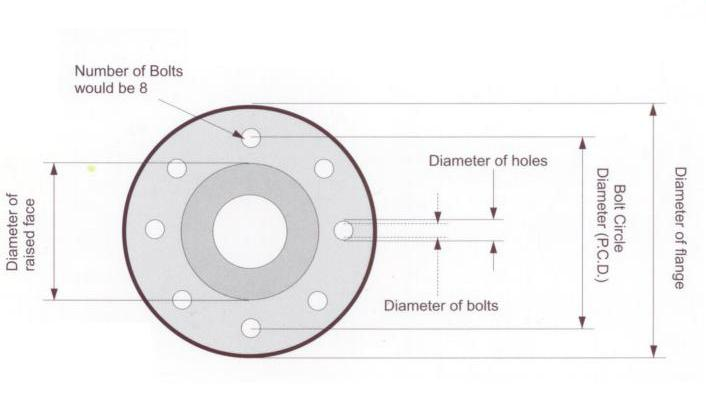
industrial carbon steel pipe Flange Dimensions

2. Universal Standards for Flange Dimensions

To maintain global compatibility, flanges are manufactured according to several major standards:

ASME/ANSI B16.5

This is the most common standard for flanges ranging from 1/2″ to 24″. It classifies flanges by “Pressure Classes” (150, 300, 600, 900, 1500, and 2500). As the class number increases, the flange becomes thicker and more robust to handle higher pressures.

ASME B16.47

For larger industrial projects requiring pipes over 24 inches, ASME B16.47 (Series A and Series B) is the go-to standard.

  • ASME B16.47 Series A flanges are thicker and heavier, designed for higher external loads.
  • ASME B16.47 Series B flanges have more, yet smaller, bolt holes and are often preferred for more compact spaces.

DIN / EN 1092-1

Used extensively in Europe, these standards use the Metric system (PN – Pressure Nominal). Common ratings include PN10, PN16, PN25, and PN40.


3. Industry-Specific Requirements: Which Size and Standard Fits Your Sector?

Different industries have unique demands regarding flange dimensions, materials, and pressure ratings. Below is a breakdown of how various sectors approach flange selection.

Oil, Gas, and Petrochemical

  • Common Sizes: 2″ to 36″ (Small for refineries, large for cross-country pipelines).
  • Standard Requirements: Typically ASME B16.5 and API 6A (for wellhead equipment).
  • Key Needs: This industry prioritizes high-pressure ratings (Class 600, 900, and 1500). Dimensions must account for “Ring Type Joint” (RTJ) facings, which are used to create a metal-to-metal seal in extreme environments.
  • Common Materials: Carbon steel (A105) and Alloy steel to resist corrosion and high temperatures.

Water Treatment and Desalination

  • Common Sizes: 24″ to 120″ (Large diameter).
  • Standard Requirements: AWWA (American Water Works Association) C207.
  • Key Needs: Because water systems operate at lower pressures compared to oil, flanges are often thinner. The AWWA standard allows for larger dimensions without the massive weight of an ASME-rated flange, making it more cost-effective for municipal infrastructure.

Chemical Processing and Pharmaceuticals

  • Common Sizes: 1/2″ to 12″.
  • Standard Requirements: ASME B16.5 and DIN/EN.
  • Key Needs: Precision is vital here. In pharmaceutical lines, “tri-clamp” or hygienic flanges are used, but for chemical transport, Stainless Steel (316L) flanges are standard. Dimensions must ensure a smooth bore to prevent “dead zones” where chemicals could accumulate and corrode the metal.

Power Generation (Nuclear and Thermal)

  • Common Sizes: Variable, but often involves high-pressure steam lines.
  • Standard Requirements: ASME Section III (Nuclear) or B31.1 (Power Piping).
  • Key Needs: Flange dimensions in power plants must accommodate thermal expansion. High-pressure steam often requires Class 2500 flanges with reinforced hubs to withstand constant vibration and heat cycles.

Shipbuilding and Marine Engineering

  • Common Sizes: 1″ to 24″.
  • Standard Requirements: JIS (Japanese Industrial Standards) or DIN.
  • Key Needs: Space is at a premium on vessels. Marine flanges often follow JIS B2220 standards, which emphasize a more compact design than their ASME counterparts while maintaining high resistance to salt-water corrosion.

Small Sizes (1/2” to 24”): Primarily used in commercial piping, HVAC, compressed air systems, light chemical facilities, and residential plumbing. These generally align with Class 150 to Class 300 pressure ratings.

Medium Sizes (24” to 60”): Frequently seen in process plants, oil & gas refineries, midstream pipelines, and power generation boilers. These require heavy-duty flanges (Classes 400 to 2500) built for high-temperature and extreme-pressure containment.

Large Sizes (60” and above): Utilized heavily in municipal waterworks, large-volume sewage treatment facilities, and wind power infrastructure. These follow standard guidelines like AWWA C207 for heavy-duty, low-pressure volume

industry pipe flange types

4. How to Ensure You Order the Right Flange

When consulting with a supplier like us, always have the following data points ready:

  1. Standard: (ASME, DIN, JIS, or AWWA?)
  2. Type: (Weld Neck, Slip-on, Blind, or Socket Weld?)
  3. Pressure Rating: (e.g., 150# vs 300#)
  4. Pipe Schedule: (For Weld Neck flanges, the internal bore must match the pipe’s wall thickness).
  5. Facing: (Raised Face, Flat Face, or RTJ?)

Conclusion

Industrial flange dimensions are more than just numbers on a chart—they are the language of global engineering. By understanding the specific needs of your industry, whether it’s the high-pressure demands of Oil & Gas or the large-scale requirements of Water Treatment, you can ensure a safer and more efficient piping system.

At RAYOUNG/JS FITTINGS, we specialize in providing high-quality flanges that meet and exceed international standards. Looking for a specific size or custom dimension for your next project? 

Contact our technical team today for expert guidance and competitive quotes.

Monday, 8 June 2026

Butt-welded Pipe Fittings VS. Threaded Fittings VS. Socket Weld Fittings

 Choosing the right connection type for an industrial piping system is a decision that resonates through the entire lifecycle of a project—from initial procurement costs to long-term maintenance and safety.

For engineers, stockists, and project managers, the choice between Buttweld, Socket Weld, and Threaded fittings is rarely arbitrary; it is governed by pressure ratings, pipe size, and the nature of the fluid being transported.

At RAYOUNG-a China industry steel pipe fittings manufacturer & exporter, we’ve spent decades manufacturing these components for global infrastructure.

In this guide, we will break down the technical nuances, pros, and cons of these three primary fitting types to help you make an informed selection for your next MTO (Material Take-Off).

1. Butt-Weld Fittings (BW): The Gold Standard for High-Pressure Pipeline Systems

Butt-weld fittings are designed to be welded end-to-end with the pipe. This creates a “full penetration” weld that essentially makes the fitting and the pipe a single, continuous piece of metal.

  • Governing Standard: ASME B16.9 (Dimensions) and ASTM A234 WPB (Material).
  • Size Range: Generally used for pipes NPS 2 and larger, though available for smaller sizes in specific high-pressure applications.

Why Choose Butt-Weld?

  • Unmatched Strength: Because the weld is as strong as the pipe itself, BW fittings are the only choice for high-pressure and high-temperature environments (e.g., steam lines or oil gas headers).
  • Leak-Proof Integrity: It provides a permanent, leak-proof connection that can withstand significant thermal expansion and vibration.
  • Smooth Internal Flow: The internal diameters of the pipe and fitting match perfectly, minimizing turbulence and pressure drop—a critical factor in long-distance transport pipelines.

The Trade-off:

Installation requires highly skilled welders and specialized equipment for “beveling” and alignment. It is also time-consuming, as multiple weld passes are often required.

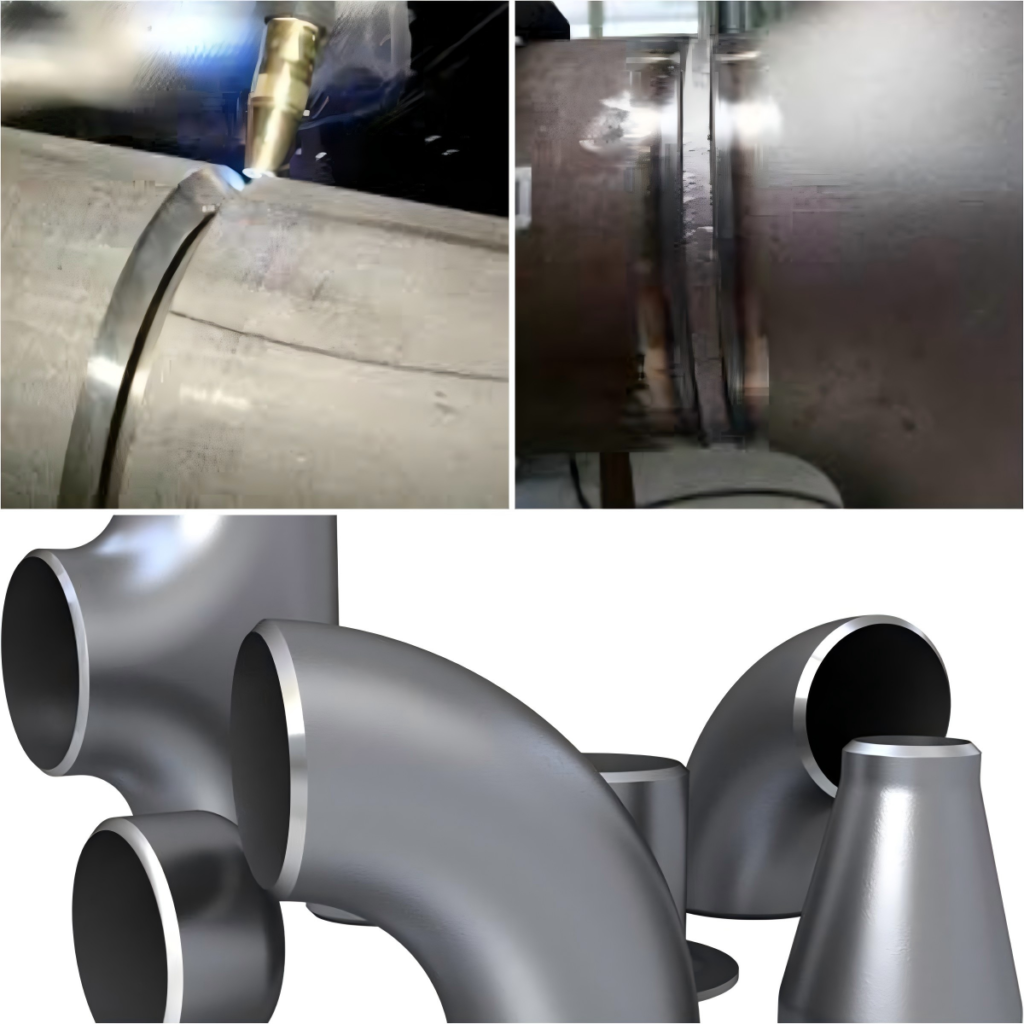
ASME B16.9buttweld pipe fittings for high pressure pipeline system

2. Socket Weld Fittings (SW): Precision for Small-Bore Piping

Socket weld fittings feature a recessed area (a “socket”) into which the pipe is inserted. A fillet weld is then applied around the top of the fitting to join it to the pipe.

  • Governing Standard: ASME B16.11.
  • Size Range: Typically used for small-bore piping (NPS 2 and below).

Why Choose Socket Weld?

  • Easier Alignment: The socket acts as a guide, making it much easier to align the pipe and fitting compared to butt-welding. There is no need for “tack welding” or complex beveling.
  • Cost-Effective Installation: Welders don’t need the same extreme level of precision required for BW, leading to faster assembly in complex, tight spaces.
  • No Weld Protrusion: Unlike buttwelding, there is no risk of weld metal “icicles” protruding into the pipe, which is vital for systems that must remain perfectly clean internally.

A Critical Technical Note (The “Gap” Problem):

The biggest pain point with SW fittings is the “expansion gap.” Industry standards (and most piping codes) require a 1/16″ (1.5mm) gap between the pipe end and the bottom of the socket to allow for thermal expansion during welding. If the pipe is bottomed out, the weld is likely to crack under stress—a common cause of failure in poorly supervised projects.

ASME B16.11 Socket Weld Fittings for Small-Bore Piping

3. Threaded (Screwed) Fittings: The Maintenance-Friendly Option

Threaded fittings connect to the pipe via tapered threads (usually NPT – National Pipe Thread). No welding is required for the primary seal, though “seal welding” is sometimes used in specific cases.

  • Governing Standard: ASME B16.11.
  • Size Range: Primarily NPS 2 and below, similar to Socket Weld.

Why Choose Threaded?

  • Zero Fire Risk: Since no welding is involved, threaded fittings are ideal for areas where sparks or open flames are prohibited (explosive environments or “hot work” restricted zones).
  • Ease of Disassembly: They are perfect for systems that require frequent maintenance, inspection, or temporary setups.
  • Lower Labor Costs: No specialized welding certification is required; basic mechanical tools are sufficient for installation.

The Trade-off:

Threaded joints are prone to leaking under high-vibration conditions or rapid temperature cycles. They are generally restricted to low-pressure, non-critical services like water, air, or lubrication systems.

ASME B16.11 Threaded pipe Fittings for Friendly Option pipeline

Technical Comparison Matrix: At a Glance

FeatureButt-Weld (BW)Socket Weld (SW)Threaded (THD)
Joint StrengthHighest (Full Strength)HighModerate
Common SizesNPS 2″ to 72″NPS 1/8″ to 4″NPS 1/8″ to 4″
Weld RequirementFull Penetration (V-Groove)Fillet WeldNone (Optional Seal Weld)
Internal FlowExcellent (Smooth)Good (Slight Step)Fair (Turbulence at threads)
Main ApplicationHigh Pressure/TempSmall-bore Process LinesLow-Pressure Utility
Cost of FittingModerateHigher (Precision Machined)Moderate

Industry Pain Points: Which One Solves Your Problem?

  1. The Corrosion Problem (Crevice Corrosion): In Socket Weld systems, the small gap between the pipe and the socket wall is a breeding ground for “crevice corrosion” in corrosive fluid service. If you are dealing with highly acidic or corrosive media, Butt-Weld is the safer long-term investment.
  2. Fatigue Failure: In systems with heavy vibration (near pumps or compressors), Threaded joints often fail at the root of the thread. Butt-Weld offers the best fatigue resistance, followed by Socket Weld.
  3. Space Constraints: In offshore modules or tight skid-mounted equipment, there isn’t always room for the bulky clamps needed for buttwelding. Socket Weld is often the “engineer’s compromise” for these scenarios.

Why Procurement Managers Trust RAYOUNG

Choosing the right type of fitting is only half the battle; the other half is ensuring the fitting actually meets the metallurgical standards it claims.

At RAYOUNG, we bridge the gap between technical requirements and project reality:

  • Standard Mastery: Whether your project calls for ASME B16.9 (Buttweld) or ASME B16.11 (Forged SW/THD), our production lines are calibrated to the tightest tolerances.
  • Material Integrity: We provide full traceability for Carbon Steel (A234 WPB, A105), Stainless Steel, and Alloy Steel. Every fitting leaves our factory with an EN 10204 3.1 Mill Test Certificate.
  • The “One-Stop” Advantage: For large-scale distributors, we provide a unified supply chain. You can source your large-diameter BW elbows and your small-bore forged SW tees in a single shipment, ensuring consistent quality and simplified logistics.
ASME B16.9 buttweld pipe fittings exporter supplier China

Final Thoughts

There is no “best” fitting—only the right fitting for the specific application.

  • Use Butt-Weld for high-pressure, large-diameter, and critical safety lines.
  • Use Socket Weld for small-bore high-pressure lines where ease of assembly is needed.
  • Use Threaded for low-pressure utility lines and areas where welding is impractical.

Still unsure which specification is right for your project’s MTO? 

Our engineering team at RAYOUNG is ready to help you navigate the complexities of global piping standards. Contact us today for a technical consultation or a competitive quote.

Email: info@hb-steel.com
Tel/WhatsApp: +86-18003119682

Wednesday, 3 June 2026

High-Performance Seamless Steel Pipe: Guide for Industrial Procurement and Bulk Sourcing

 In critical industrial infrastructure—ranging from high-pressure oil and gas lines to complex refinery systems—the integrity of the piping network is non-negotiable. For engineers and stockists, the choice often begins and ends with seamless steel pipe.

Unlike welded steel pipe, seamless pipes offer a level of structural uniformity that is essential for demanding environments.

At RAYOUNG, we understand that for a seamless steel pipe wholesales bulk supply to be successful, it must balance three pillars: uncompromising quality standards, logistical reliability, and factory-direct cost efficiency.

The Engineering Advantage of Seamless Pipes

The primary reason industries opt for seamless pipes is the absence of a longitudinal weld seam. This lack of a seam eliminates the risk of “seam failure,” a common vulnerability in welded pipes when subjected to extreme internal pressure or corrosive fluids.

Produced through a process of piercing a solid billet, the resulting pipe features a consistent grain structure. This makes it the preferred choice for ASTM A106 and API 5L applications, where thermal expansion and high-stress mechanical loads are part of daily operations.

 seamless steel pipe wholesales bulk supply

What is the difference between mild steel pipes and seamless steel pipes?

One of the most frequent questions we encounter from procurement teams is: “What is the difference between mild steel pipes and seamless steel pipes?”

It is important to clarify that these two terms refer to different aspects of the pipe:

  1. Mild Steel Pipe refers to the material composition. Mild steel is a type of carbon steel with a low carbon content (usually between 0.05% and 0.25%). It is known for its ductility and weldability but has lower tensile strength compared to high-carbon or alloy steels.
  2. Seamless Steel Pipe refers to the manufacturing process. A pipe can be made of mild steel and be seamless.

The confusion usually arises because many “mild steel pipes” found in the market are ERW (Electric Resistance Welded). When compared to seamless pipes, mild steel welded pipes are generally more cost-effective for low-pressure applications like water transport or scaffolding. However, for high-pressure industrial use, a seamless carbon steel pipe—regardless of whether it is mild or high-carbon—is vastly superior in terms of burst pressure and safety margins.

Partnering with a Reliable Seamless Carbon Steel Pipe Supplier

For global distributors and stockists, the challenge isn’t just finding a product; it’s finding a consistent seamless carbon steel pipe supplier. In the B2B sector, “quality” isn’t just a buzzword—it’s documented.

RAYOUNG ensures that every batch of seamless pipe meets international benchmarks, including:

  • Dimensional Accuracy: Ensuring wall thickness consistency (SCH 40, SCH 80, XXS) across the entire length.
  • Certification: Providing full Mill Test Certificates (MTC) in accordance with EN 10204 3.1/3.2.
  • Third-Party Approval: Our products are verified and approved by major energy entities such as ADNOC, NIOC, and PETROBRAS, giving our partners a competitive edge in tender bidding.

Streamlining Your Supply Chain with Wholesale Bulk Supply

Managing inventory for a warehouse or a large-scale project requires more than just a purchase order. It requires a manufacturer that understands the nuances of seamless steel pipe wholesales bulk supply.

We specialize in high-volume exports, offering:

  • Consolidated Shipments: Bundling seamless pipes with our own manufactured buttweld fittings (elbows, tees, reducers) to reduce freight costs and simplify customs clearance.
  • Protective Coatings: From black painting and oiling to 3LPE or Galvanized finishes, ensuring the pipes arrive at your job site or warehouse in pristine condition.
  • Custom Lengths: Meeting specific project requirements to minimize on-site waste.

Conclusion: Looking for a Long-term Factory Supply Partner?

In the global steel market, price gets you noticed, but reliability keeps you in business. Whether you are a distributor looking to replenish your stock or a contractor managing an EPC project, choosing the right source is the first step toward project success.

RAYOUNG invites industrial stockists and engineering firms to discuss their bulk requirements. Our facility is geared toward large-scale production, ensuring that your supply chain remains robust and your projects remain on schedule.

Ready to discuss your next bulk order?
Contact our export team today for a comprehensive quote and technical consultation.

Email: info@hb-steel.com
Tel/WhatsApp: +86-18003119682

API 5L Seamless Steel Pipe (Line Pipe)

  API 5L Seamless Line Pipe High-Pressure Energy Transmission Solution Grades: Gr.B, X42, X46, X52, X56, X60, X65, X70 Standards: API Spec...